Introduction
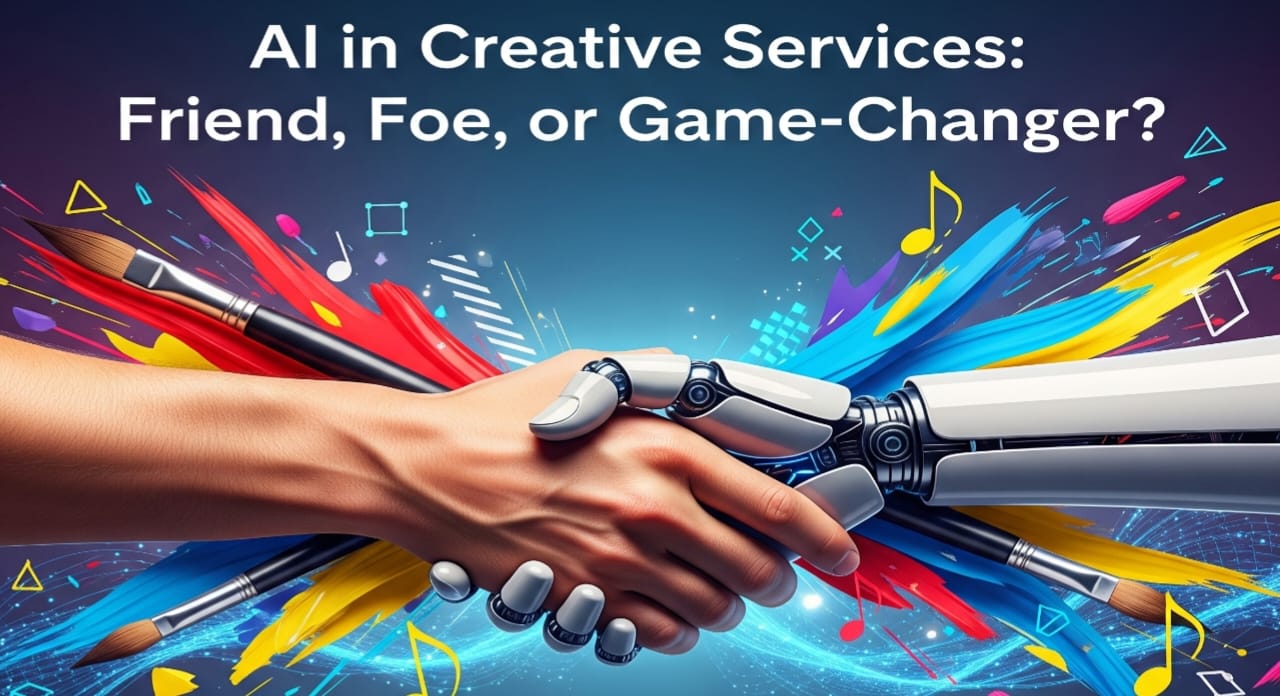
Artificial Intelligence (AI) is rapidly transforming the landscape of creative services. From graphic design and video editing to content creation and music, AI offers a mix of excitement, opportunities, and ethical questions. Is AI a helpful collaborator, a threat to originality, or the industry’s greatest disruptor yet? Let’s explore what makes AI a friend, a foe, and—perhaps most importantly—a game-changer in creative services.
Table of Contents
- What is AI in Creative Services?
- How AI is Transforming Creative Work
- AI as a Creative Partner (Friend)
- Challenges and Critiques (Foe)
- AI as an Industry Game-Changer
- Real-World Examples & Tools
- FAQs
- Conclusion & Call to Action
What is AI in Creative Services?
AI in creative services refers to the use of machine learning, generative algorithms, and automation tools to assist or enhance tasks typically reserved for human creativity. This can include designing graphics, composing music, editing videos, writing content, and more.
How AI is Transforming Creative Work
- Design & Illustration: AI generates and remixes images, explores new aesthetics, and automates routine creative tasks with tools like Stable Diffusion and Artbreeder. Designers can iterate faster, try more ideas, and focus on strategic creativity.
- Video Production: AI-driven platforms like Runway and Lumen5 automate editing, subtitles, and even convert blog posts into videos, speeding up content production.
- Writing & Content Generation: Tools like ChatGPT and Jasper assist with brainstorming, editing, and large-scale content creation—from social posts to newsletter drafts.
- Personalization: AI can tailor content to individual users, providing a unique experience in areas like digital marketing, web design, and entertainment.
AI as a Creative Partner (Friend)
AI acts as a powerful co-pilot, offering:
- Enhanced Inspiration: AI suggests new styles, techniques, or solutions—even for those with limited training—broadening access to creativity.
- Efficiency Gains: Automation of repetitive tasks frees up human creatives to focus on ideation and complex problem-solving.
- Collaboration: AI enables teams to work smarter and produce more—faster. It helps narrow down ideas, test concepts, and provide data-driven design decisions, all while keeping creative direction in human hands.
- Inclusion: By lowering barriers, AI helps democratize creative industries, making them accessible to a wider, more diverse group of people.
“AI isn’t the artist. It’s the assistant. When human emotion meets AI’s capability, we get something more powerful than either can do alone.”
Challenges and Critiques (Foe)
While AI offers many advantages, it brings concerns:
- Originality and Homogenization: Over-reliance could lead to “same-sounding” or derivative outputs, as similar AI tools and prompts produce comparable results.
- Human Element: AI can remix and repurpose, but it cannot truly feel or innovate with emotion—yet. Human intuition and empathy are irreplaceable in compelling creative work.
- Job Security & Evolving Roles: There’s fear of jobs being replaced by automation, though history shows technology often creates new roles and opportunities.
- Ethical Considerations: Issues like deepfakes, copyright, and content authenticity remain tough challenges for the industry.
AI as an Industry Game-Changer
AI is more than just a time-saver—it’s fundamentally redefining the creative process:
- Boosted Productivity & ROI: With automation of labor-intensive tasks, creative businesses see faster delivery, innovation, and increased revenue.
- Rapid Prototyping & Trend Forecasting: AI helps predict consumer interests and rapidly generate design variants or campaign concepts.
- Breaking Language & Access Barriers: AI-powered tools translate content, making creativity more global and inclusive.
- Collaborative Revolution: The future will demand “AI-fluent” creatives who can direct, curate, and guide machine-generated ideas into human-centered experiences.
Real-World Examples & Tools
- Design: Canva, Adobe Sensei, and DeepArt for layout suggestions and artistic effects.
- Video: Runway ML and Kaiber for fast video editing and motion graphics.
- Writing: Jasper and ChatGPT for ideation and draft generation.
- Marketing: Personalization engines and recommendation systems to craft targeted campaigns.
FAQs
Q: Will AI replace human creativity?
A: AI automates and accelerates but cannot replace the emotional depth, intuition, and unique expression of human creators. The best results come from collaboration.
Q: Is AI a threat to creative jobs?
A: AI changes roles but also creates new opportunities—those who adapt and learn to work with AI will thrive.
Q: What are the limitations of AI in creative services?
A: AI struggles with the emotional nuance and originality that defines memorable creative work. It excels at amplifying, not replacing, human vision.
Conclusion & Call to Action
AI in creative services is both a friend and a foe—but above all, it’s a game-changer. When creators harness the power of AI as a collaborator, they unlock unprecedented efficiency, inspiration, and innovation, all while preserving the essence of human creativity. The key lies not in fearing the tool but in mastering it—using AI to elevate, not eliminate, the artist’s voice.